What Is the f-Number on a Lens?
If you have ever seen numbers like f/1.8, f/2.8, or f/8 on your lens or camera screen, you were looking at the f-number. It is one of the most important settings in photography, because it affects both how much light enters the camera and how much of the image looks in focus.
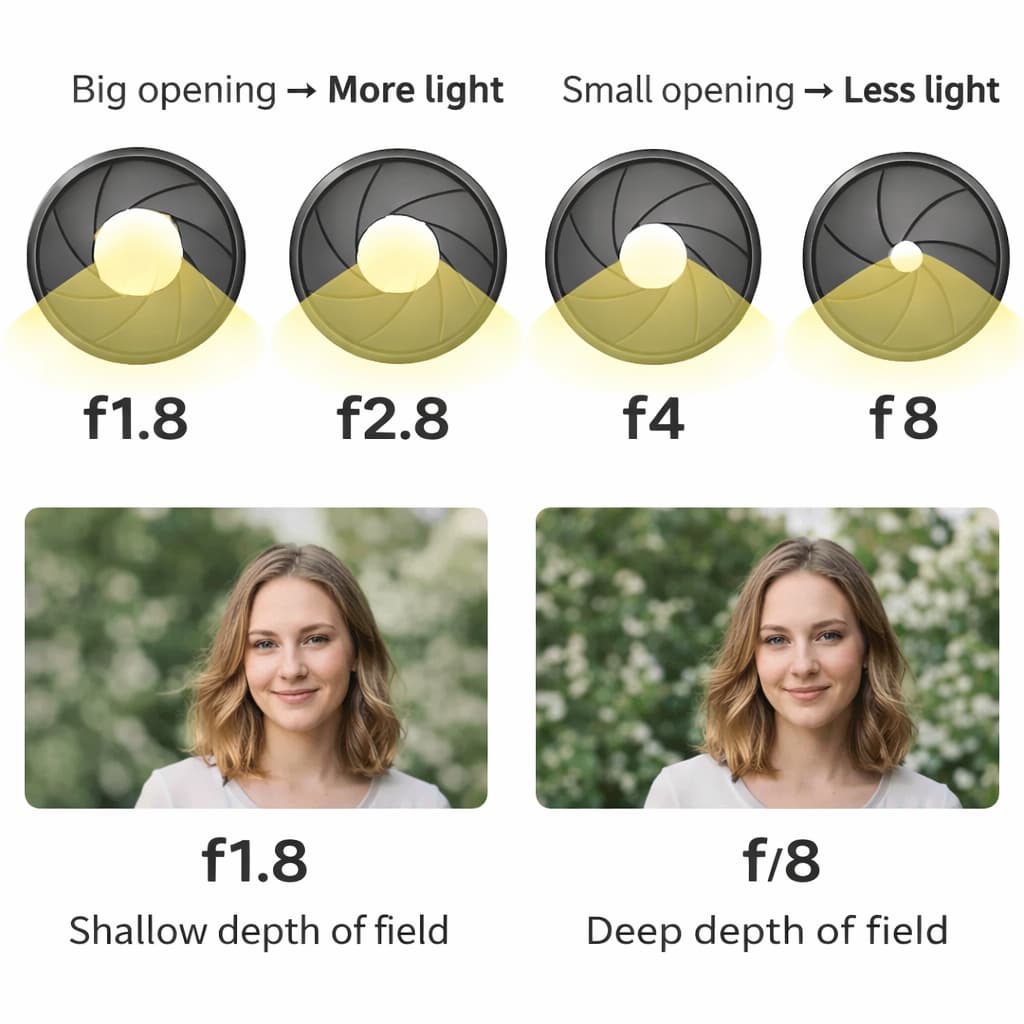
The simple explanation
The f-number describes the size of the lens opening, also called the aperture. When the opening is wide, more light can pass through the lens. When the opening is small, less light gets in.
So in practical terms:
- f/1.8 means a large opening
- f/8 means a much smaller opening
This is why photographers often use low f-numbers in dark conditions or when they want a soft, blurry background.
The most important thing to remember: a lower f-number does not mean a smaller opening. It means a bigger opening.
Why do the numbers feel backwards?
This confuses almost everyone at first. The reason is that the f-number is a ratio, not a simple size label. You do not need the math to use it well, but the result is this:
- Lower number → larger aperture opening
- Higher number → smaller aperture opening
That is why f/1.8 lets in more light than f/8.
How the f-number affects your photos
The f-number changes two major things in your image: brightness and depth of field.
1. Light
A wide aperture such as f/1.8 allows more light into the camera. This helps in low-light situations like indoor portraits, wedding receptions, or evening sessions.
A narrower aperture such as f/8 allows less light in, so you may need to compensate with a slower shutter speed or higher ISO.
2. Depth of field
Depth of field refers to how much of your image appears acceptably sharp from front to back.
- f/1.8 gives you a shallow depth of field
- f/8 gives you a deeper depth of field
In other words, a low f-number is great when you want your subject to stand out against a soft background, while a higher f-number is better when you want more of the scene to stay sharp.
Real examples
- Portraits: f/1.8 to f/2.8 for background blur and subject separation
- Group photos: f/4 to f/8 to keep more faces in focus
- Landscapes: often f/8 or higher for more overall sharpness
- Low-light events: lower f-numbers help gather more light
Do not confuse f-number with focal length
This is one of the biggest beginner mistakes. The f-number and focal length are completely different things.
- f-number controls aperture, light, and depth of field
- focal length controls angle of view and how zoomed in the image looks
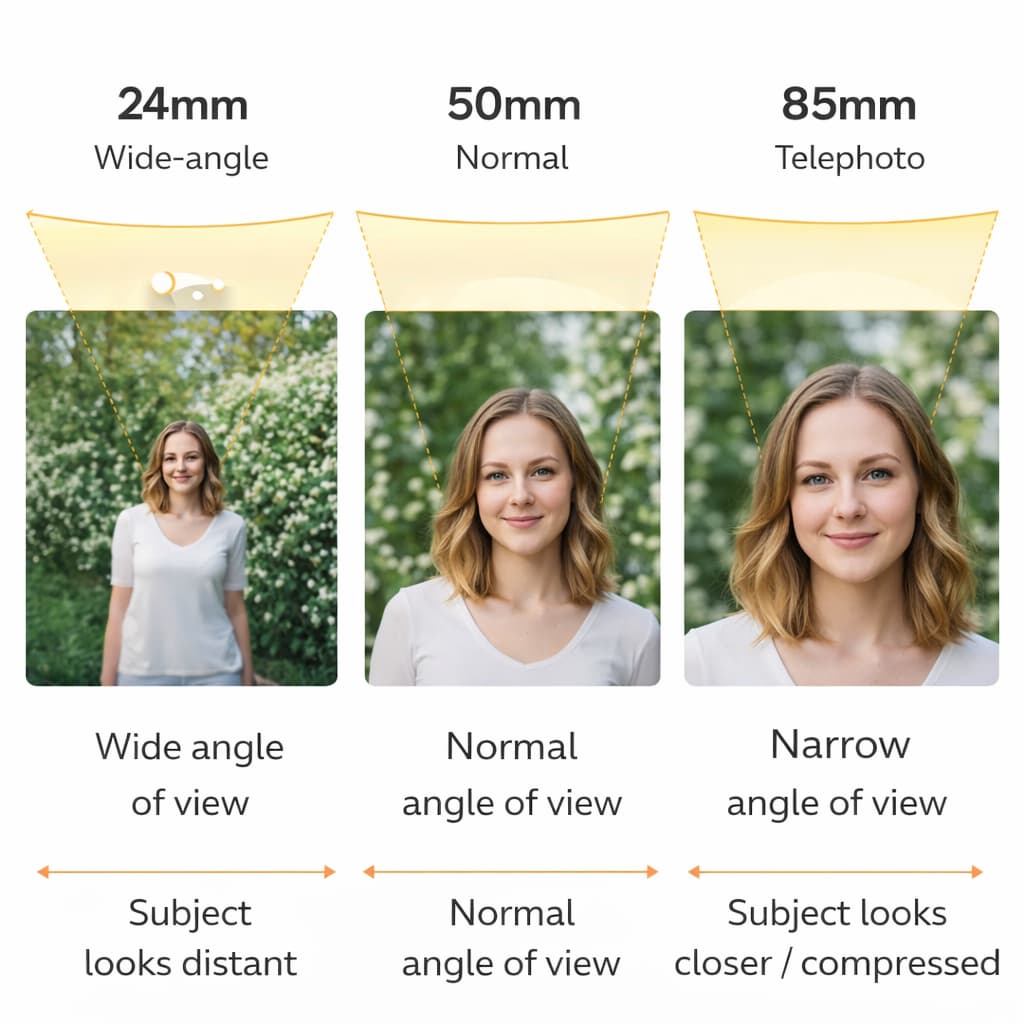
What focal length changes
Focal length is measured in millimeters, such as 24mm, 50mm, or 85mm.
- 24mm gives a wide angle of view and includes more of the scene
- 50mm looks more natural and balanced
- 85mm gives a tighter view and a more compressed look
So if you change from 24mm to 85mm, you are not changing the aperture. You are changing how wide or narrow the scene appears.
Quick rule: f-number changes the opening. Focal length changes the view.
Why this matters in real shooting
In real life, both settings work together. For example, an 85mm lens at f/1.8 can create a very strong background blur and a very thin plane of focus. That can look beautiful, but it also makes focusing more critical.
This is one reason culling portrait and wedding photos can take time. When you shoot wide open, many frames may look similar at first glance, but the differences in eye sharpness or focus accuracy can be subtle. That is exactly where careful review matters.
Final takeaway
The f-number tells you how wide the lens aperture is. A lower f-number like f/1.8 means more light and a blurrier background. A higher f-number like f/8 means less light and more of the image in focus.
Focal length is different. It tells you how wide or narrow your view will be, such as 24mm, 50mm, or 85mm.
Once you understand the difference between these two settings, photography starts making a lot more sense.
In one sentence
f-number controls light and blur; focal length controls view and framing.